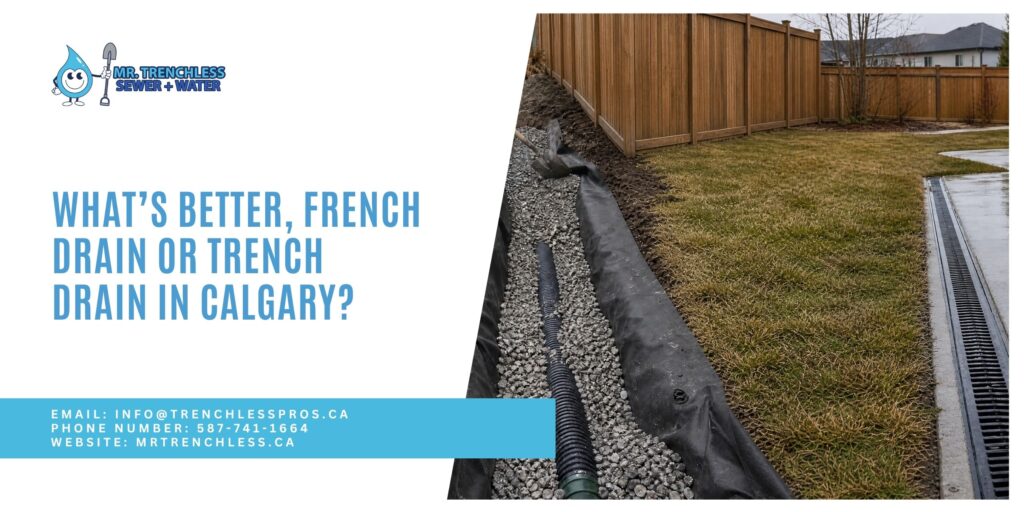
Water pooling in your yard, soggy basement or drainage problem around your home’s foundation? If you’re dealing with any of these issues, your two options are French drains and trench drains. Although the names are similar and they both involve moving water away from where it doesn’t belong, they work differently, solve different problems and are made for certain situations.
Which is better? It ultimately comes down to the drainage problem. Here’s what you need to know to make the right call for your Calgary property.
Table of Contents
ToggleWhat is a French Drain?
Ironically, French drains have nothing to do with France. The name comes from Henry French, a 19th-century farmer who popularized the concept. A French drain is a subsurface drainage solution, which collects and redirects groundwater and subsurface water before it runs into an issue.
It’s made of a perforated pipe wrapped in filter fabric surrounded by gravel and buried underground. Water seeps into the gravel and enters the perforated pipe through small holes and flows away from the problem area, toward a drainage outlet, a dry well or the municipal storm system.
French drains most commonly:
- Redirect groundwater away from a foundation or basement
- Drain a yard or lawn that retains water after rain or snowmelt
- Protect weeping tile systems in Calgary around the perimeter of a home
- Manage subsurface water in sloped or low-lying areas
A French drain is buried, but it’s largely invisible following installation. There’s no visible channel or grate on the surface.
What is a Trench Drain?
A trench drain (a channel drain or linear drain) is a surface drainage solution. Instead of capturing subsurface water, it collects water that’s already on the surface and channels it away quickly.
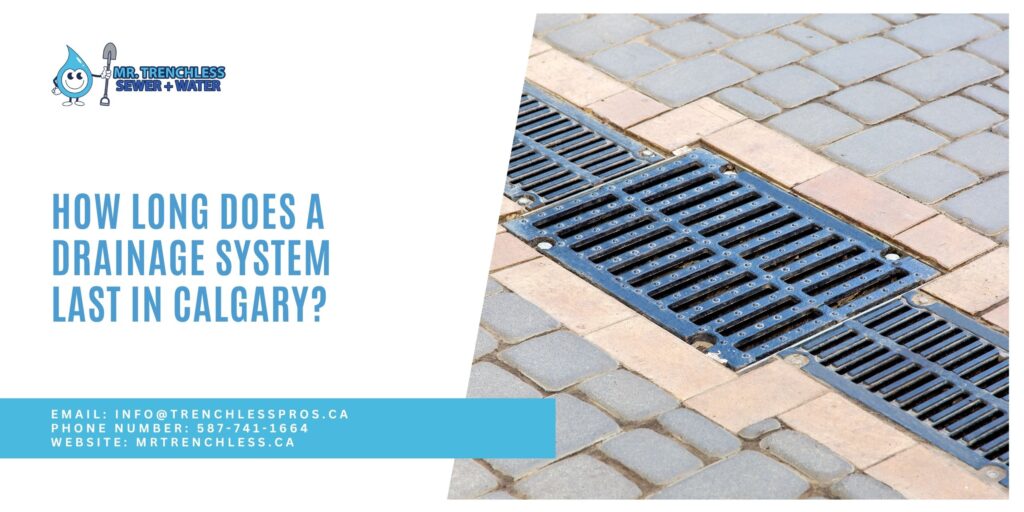
Generally, a trench drain is a long, narrow channel set into a hard surface like a driveway, patio, walkway or concrete pad that’s covered with a grate. Surface water flows across the hard surface, into the grate and through the channel to a designated outlet.
Common uses for trench drains include:
- Draining water from driveways, garage aprons and parking areas
- Managing runoff on patios, pool decks and walkways
- Preventing water from flowing into garages or toward building entrances
- Handling snowmelt runoff on paved surfaces
Unlike a French drain, a trench drain is visible. The grate sits at surface level and is part of the hardscape.
What are the Key Differences Between French Drains and Trench Drains?
Although they serve similar purposes, French and trench drains are not the same. The big question, where’s the water? Here’s what you need to know:
- French Drain: It manages water underground or subsurface by intercepting water moving through the soil before it reaches your foundation, basement or low-lying yard areas.
- Trench Drain: Managing water on the surface, it captures runoff from paved or hard surfaces and channels it away before it pools or flows where it shouldn’t.
Basically, if your issue is underground water and a soggy lawn, you need a French drain. In contrast, a trench drain is better for surface runoff on a driveway or patio.
What is Better for Calgary Properties?
One isn’t better than the other. However, Calgary conditions favour certain applications. Here’s an overview:
When French Drains Work in Calgary
Calgary has clay-heavy soil, which leads to poor natural drainage. Clay doesn’t absorb water, it holds it. When rain or snowmelt saturates clay soil, there’s nowhere for the water to go. A French drain intercepts subsurface water and redirects it away from the foundation.
Calgary has freeze-thaw cycles that create significant groundwater movement. When snow melts in the spring, large volumes of water move through and over the soil. French drains prevent this seasonal surge from causing basement flooding or foundation damage.
Weeping tile systems can help. They help with perimeter drainage around the foundation of Calgary homes like a French drain does. When these systems fail, a French drain replacement or upgrade makes the most sense.
When Trench Drains Work in Calgary
Have a paved driveway, garage apron or parking pad that collects runoff from the street or roof? When the snow melts in Calgary, surface water can pool on paved surfaces and a trench drain at the low point of a driveway or garage is the best way to manage it.
If you have a patio or deck that causes water to pool against the house after rain, consider a trench drain. Having one along the edge of a paved area will capture runoff before it reaches the foundation or enters the basement.
Can You Use Both?
Of course! In fact, they are usually necessary for Calgary properties. A common setup involves a trench drain at the garage apron or driveway entrance to capture surface runoff combined with a French drain or weeping tile system around the foundation to manage subsurface groundwater. The two systems address different parts of the same overall drainage challenge.
At Mr. Trenchless, we believe scheduling an assessment is the best way to get the full picture. Between surface water, subsurface water, foundation exposure, soil conditions and grading, we can recommend the right combination of solutions for your property.
What Does Installation Look Like?
Both options require excavation. However, overall scopes can vary. Here’s a quick breakdown of each:
French Drain Installation
The process begins with excavating a trench along the area where water is collecting or near the foundation perimeter. From there, your contractor will lay filter fabric, place gravel and perforated pipe, wrap fabric over the top and backfill. In Calgary, depth is important. The pipe must sit below the frost line to function properly through freeze-thaw cycles.
Trench Drain Installation
It starts with cutting a channel into an existing hard surface and forming one during initial paving. Next, it’s time to set the prefabricated channel and grate, connect the outlet to a drainage point and finish the surrounding surface.
Both types of installations require proper grading and outlet planning. If the drain has nowhere to send the water, it’s moving the problem, not solving it.
Hydrovac excavation is the way to go when it comes to French drain installation in Calgary, especially near utilities or existing infrastructure. It precisely exposes the trench without damaging surrounding systems and is one of Mr. Trenchless’s specialties.
What are the Signs You Need One or Both in Calgary?
You may need a professional drainage system assessment if you notice:
- Water pooling in your yard after rain or snowmelt that takes days to drain
- A wet or damp basement without an obvious interior source
- Water flowing across your driveway or toward your garage during heavy rain or spring melt
- Efflorescence (white mineral deposits) on basement walls indicate water movement through the foundation
- Soft or spongy ground near the foundation
- Ice forming on your driveway or walkway from pooling water that doesn’t drain before it freezes
When Calgary’s spring melt rolls around, drainage problems emerge. If you’re dealing with any of these problems during the spring, it’s worth addressing before the next cycle.
What Can Mr. Trenchless Do for You?
French drains and trench drains solve different problems. French drains manage subsurface groundwater while trench drains manage surface runoff. In Calgary, clay soils, heavy snowmelt and freeze-thaw cycles create year-round drainage challenges, but they each have an important role. At Mr. Trenchless, we can tell you that most properties benefit from a combination of both. We’ll give you an honest assessment and tell you the best option for your problem.
Wondering if you need a French drain or trench drain? Contact us to schedule a drainage system assessment today!